Filter By

The visual summary accompanies a report led by SEFARI researchers (James Hutton Insitute) and commissioned by the Scottish Government which comprises the findings of an evidence review to inform the further development of the Scottish Land Matching Service. This visual summary has been produced by the Scottish Government based on the findings of the main report. The SLMS was established in 2019 as an initiative of Scottish Government’s Farming Opportunity for New Entrants Group. The SLMS mandate is to enable joint ventures in farming. 

This presentation presents highlights from a review of the Scottish Land Matching Service, contextualising progress to date against land matching services elsewhere in the United Kingdom and Republic of Ireland and providing feedback from participants

This report was requested to better understand the implications of not controlling bracken on biodiversity, rural productivity and public health, where asulam is traditionally used for its control in Scotland.

Asulam, sold under the trade name Asulox, is a relatively narrow-spectrum herbicide that has been the predominant chemical method of bracken control, particularly on rough or steep ground since the 1980s. Authorisation for Asulox was removed in 2012 with all recent use subject to emergency authorisation which has been given on an annual basis.

This presentation discusses the current and potential future impacts of innovations in ruminant improvements, highlighting their role in achieving a cost-effective and sustainable reduction in livestock greenhouse gas emissions (GHGs) from Scotland in the short, medium, and longer term.  By focusing on traits that underpin sustainability, providing farmers with effective tools, and leveraging advancements in genetic selection and breeding technologies, we can achieve cost-effective and sustainable reductions in livestock GHG emissions.

SEFARI researchers (James Hutton Institute and SRUC) provide analytical support and expert advice to inform future agricultural policy decisions in Scotland. They provided expert and analytical support for the Agriculture Champions, the Farmer Led Groups and the Agriculture Reform Implementation Oversight Board (ARIOB).

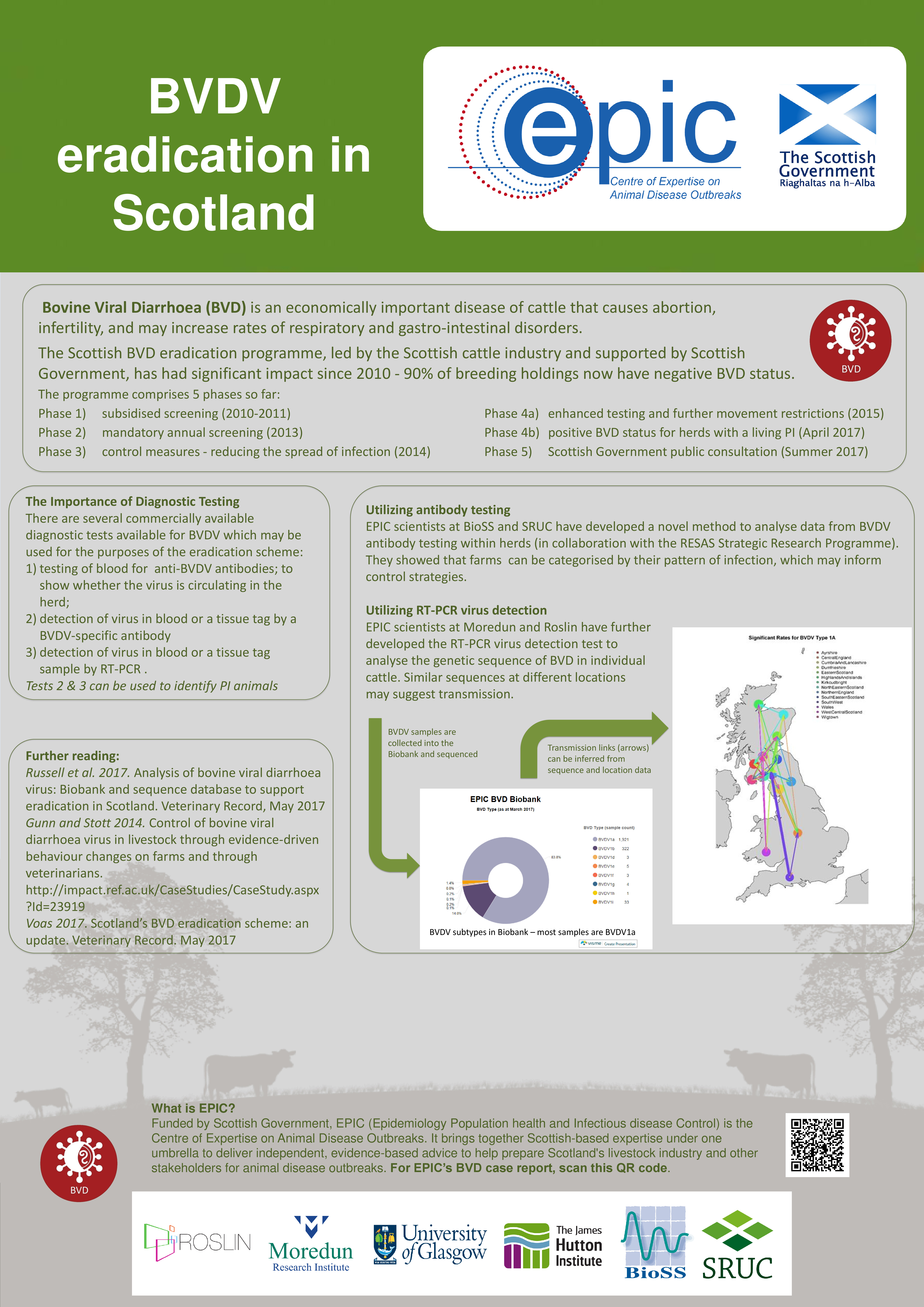
Scotland’s eradication programme for Bovine viral diarrhoea (BVD) is based on animal health, economic and environmental benefits. Typing of BVD-positive samples allows analysis of virus spread and detection of reportable BVD type 2. Presented at the RESAS Science, Evidence and Policy Conference 18 May 2023 by George Russell, Moredun Research Institute; Andrew Barnes, SRUC and Nathan Liddle, BVD Policy Team.

Environment, Natural Resources and Agriculture Science, Evidence and Policy Conference – Prof. Mathew Williams

Keynote presentation, RESAS Conference 2023.

  • SEFARI Gateway
  • 'Bridging the gap between science and policy to achieve our climate and nature goals' - Simon Fuller

    Keynote presentation, RESAS Conference 2023.

  • SEFARI Gateway
  • A free online tool was developed to assist farmers, vets and livestock health advisors in the interpretation of the clinical implication of faecal egg count (FEC) results from sheep.

  • Animal Health & Welfare
  • Organised by SEFARI Gateway and led by Newsdirect & SPICe, this training session wa

  • SEFARI Gateway
  • Organised by SEFARI Gateway and led by Newsdirect & SPICe, this training session wa

  • SEFARI Gateway
  • The aim of this SEFARI Spark/Think Tank project, designed to scope current topical issues, was to identify research priority areas for agri-tech use in beef and sheep livestock production systems, where uptake is currently limited. A survey was developed to capture this information, and was distributed between June and August 2020. Opinions on limitations and barriers to uptake were collected. In total, there were 71 responses from a range of respondents including farmers, crofters, consultants, farm advisors, veterinarians and academics/researchers.

    This project is supporting the NatureScot Scientific Advisory Committee avian influenza sub-group to increase capacity for wild bird testing for both passive and active surveillance to fully identify the scale of the problem and to support decision making in reducing the spread and impact of this disease.


    This report provides selected highlights from the year 2021-22 of the Scottish Government-funded Strategic Research Programme (SRP). The SRP, and its underpinning of SEFARI, is delivering integrated, interdisciplinary research that is creating significant innovation and practice change. The SRP also underpins expertise available for policy advice. Central to this success are SEFARI’s enduring relationships with policy, agency, business and civic sectors across Scotland, UK and globally.

    This report summarises the extensive and multifaceted impacts arising from the Strategic Research Programme 2016-2022, supporting Scotland’s commitment to UN Sustainable Development Goals and including impacts showcased throughout COP26.

    The report is organised by the three themes of the Strategic Research Programme and lists the outputs and outcomes related to support for policy and practice, innovation and the economy, collaboration and multidisciplinary research, and scientific excellence and scientific resilience.

    Jonathan Hopkins1, Nick Schurch2, Andy Sarjeant3, Catherine MacNeil3, Mags Currie1, Eilidh MacDonald3, Rachel Forrest3, Heather Smith3, Robin Clarke3

    1 Social, Economic and Geographical Sciences Department, The James Hutton Institute; 2 Biomathematics and Statistics Scotland; 3 Highlands and Islands Enterprise.

  • Land and Communities
  • SEFARI Gateway is delighted to provide funding for a new Fellowship with the Cairngorms National Park Authority as part of the Cairngorms 2030 programme. 

    The climate emergency presents a double challenge for public bodies as they reduce their greenhouse gas emissions and learn to adapt to the already changing climate. The Scottish government is committed to deliver a Just Transition to Net Zero by 2045 meaning that public entities must come up with innovative ways to meet these targets.

    The Loch Lomond and the Trossachs National Park covers a largely rural area in the west of Scotland and want to address the ‘wicked issues' of rural car dependency and carbon-intensive travel to LLTNP.