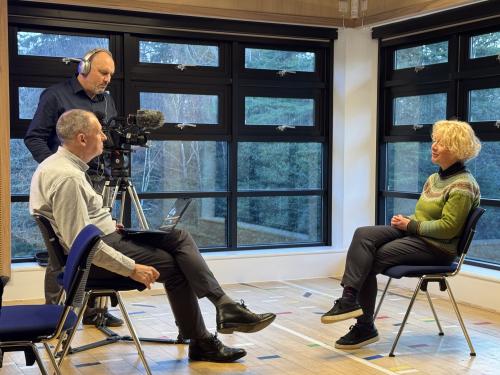
How would you cope if you were asked to describe the impact and relevance of your work in 15 second sentences while staring directly into a television camera?
For many people the answer is they just don’t know until placed in this situation. What may sound like a simple task can be very challenging when under pressure.
Some thrive, but others waffle, some freeze, others get cross, some go blank and some even forget to breathe – but almost every response can be ironed out and improved with practice, ultimately enabling strong and confident communication.
And that’s why providing opportunities to practice for those likely to engage with journalists is crucial. To this end, SEFARI Gateway, backed by the Scottish Government, last month rolled out a programme of in-depth media training.
Twenty nominated researchers and staff from across the SEFARI institutes took part in the training provided by David Lee Media and Events, with the aim of increasing the pool of people who have the skills to communicate clearly and concisely with a general audience about their area of expertise.
The training team, made up of a former assistant newspaper editor, a working journalist and a cameraman, gave a detailed update on the current media landscape and then talked through twelve top tips for media interviews.
Then each participant was put through two realistic media interview scenarios, which were filmed and played back to spot opportunities for praise and improvement.
Key aspects of giving a strong interview included:
• Remembering to breathe and take pauses
• Avoiding jargon and acronyms
• Avoiding words or phrases that stop a listener or viewer in their tracks because they are too specialist
• Not repeating negatives posed in questions
• Naming their institute as regularly as possible
• Repeating key messages – don’t get bored by saying the same thing again and again
• Talking as though describing your research to a non-expert family member or friend in a pub or coffee shop
In the first of the two mock media interviews given to each participant, the training team were fairly gentle, giving the participants a chance to practice putting across key messages and points clearly and concisely. This interview was conducted with a journalist sitting in front of the participant, so they had a real person to talk to.
However, if participants performed well in the first interview, the training team introduced more challenging scenarios. And the interviewer stood off to the side, leaving the participant to look only down the barrel of the camera: a realistic scenario for an interview in today’s media landscape where an interview may be conducted over a screen without the journalist being visible to the interviewee.
Challenging lines of questioning from the training team included:
• Making the questions personal: in his mock-interview on Ultra Processed Food Professor Jules Griffin, director of The Rowett Institute, was asked whether he ate any such food himself.
• Asking politically sensitive questions (which needed to be swerved so the participant could return to the key messages they wanted to deliver): in her mock interview Dr Valentina Busin, head of virus surveillance at the Moredun Research Institute, was asked if Donald Trump was correct to blame Chinese lab experiments for causing the coronavirus outbreak.
• Asking participants for opinions about controversial subjects that may put them at odds with a stance their institute would want to take.
• Intentionally asking provocative questions to try to annoy the participants.
The participants used the techniques they had been taught to avoid these pitfalls, to swerve questions that were outside their research area, and to bridge back to the messages they wanted to deliver. “Sticking to their knitting,” as journalist Peter Ranscombe, on the training team, put it.
To emphasise the importance of getting the message right, the training team described how, in today’s media landscape, even an interview carried out in a traditional format, such as by a newspaper or radio journalist, is likely to be published online, often as a video clip.
This can then be repeated and collated in many different forms, whether on platforms such as Substack, or as AI generated summaries on the internet. So that message will be repeated again and again.
As trainer David Lee put it so memorably, the internet is a bit like a sausage machine churning out the same information repeatedly.
He said: “You don’t want a negative message to go into the doom loop of the internet sausage machine”.
Why engage in the first place if there are so many pitfalls to avoid? As the training team pointed out, in most cases a journalist won’t be looking to catch an interviewee out but only wants their expertise. It’s just good to be aware of, and able to cope with, worst-case scenarios.
And contributing to media conversations about science and research not only adds important facts, evidence and information to debates, it raises the profile of individual researchers and promotes their institutes. When pressure on the public purse only seems to increase, it’s extremely useful to be able to promote the importance, impact and value of research.
SEFARI institutes are involved in a huge number of newsworthy areas of research, from Ultra Processed Foods, to methane emissions from cattle, water quality, biodiversity losses, future of farming, and many, many more. The opportunities to engage are almost endless, and these opportunities are valuable.
To summarise: like a good media interview, if this blog has three key messages, these would be:
One - When giving a media interview, remember to breathe and take pauses.
Two – Get media trained if you have the chance, and then put this into practice by giving a real media interview (with the agreement of your comms team)
And finally, keep those sausages (nice succinct messages) positive!
Blog written by Jenny Fyall, SEFARI Research and Communications Manager
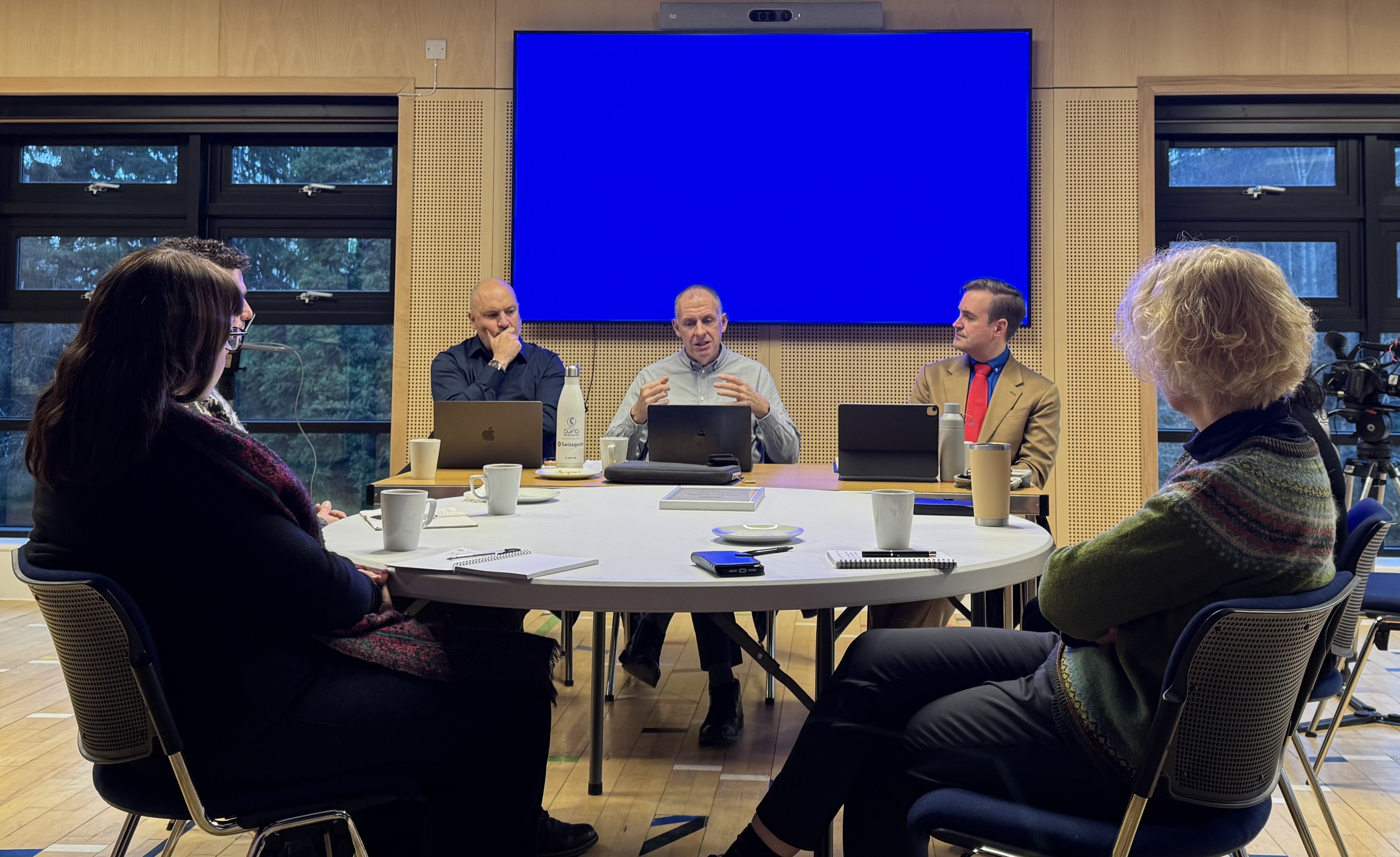
David Lee Media and Events Training team with course participants. Photo credit: Amy Cooper
If you'd like more information on the training please see our report, which can be accessed through the following link - Media training: finding new SEFARI trusted communicators - Report | SEFARI