Scotland's growing deer population presents major environmental, economic and public safety challenges, making sustainable deer management an increasingly important policy priority. Creating stronger markets for venison is essential to improving the economic viability of deer management and increasing the utilisation of sustainably sourced wild deer. This study investigated UK consumers' and pet owners' preferences and willingness to pay for venison-based products for human consumption and pet food, and evaluated the effectiveness of pricing strategies, product claims and information provision in increasing demand. The findings identify practical interventions that can support businesses and policymakers in expanding venison markets and strengthening the contribution of sustainable deer management.
Image credit: Johan Mouchet unsplash

Stage
Purpose
Wild deer populations have increased substantially across Scotland and other parts of the UK over recent decades. In many areas, deer numbers now exceed the carrying capacity of local habitats, contributing to woodland degradation, biodiversity loss, damage to agricultural crops, and increased deer–vehicle collisions. Sustainable deer management has therefore become an important environmental, economic and public safety priority.
Achieving sustainable deer population management requires continued investment from land managers, deer managers, game processors and other businesses involved in the venison supply chain. However, these activities are costly and their long-term economic viability depends on the existence of a strong and reliable market for venison. Although venison is a nutritious, locally produced and environmentally sustainable source of protein, consumer demand in the UK remains relatively low, limiting market incentives to increase supply. Expanding the use of venison beyond traditional markets, particularly through innovative products for both human consumption and pet food, could create new commercial opportunities and improve the economic sustainability of deer management. The pet food sector is particularly promising because it can utilise a wider range of venison raw materials while complementing the human food market.
This study addresses an important evidence gap by providing quantitative evidence on consumers' and pet owners' preferences and willingness to pay for venison-based products. It also evaluates the effectiveness of different interventions, including pricing strategies, product labelling, and information provision, in increasing product acceptance and willingness to pay.
Results
Methods
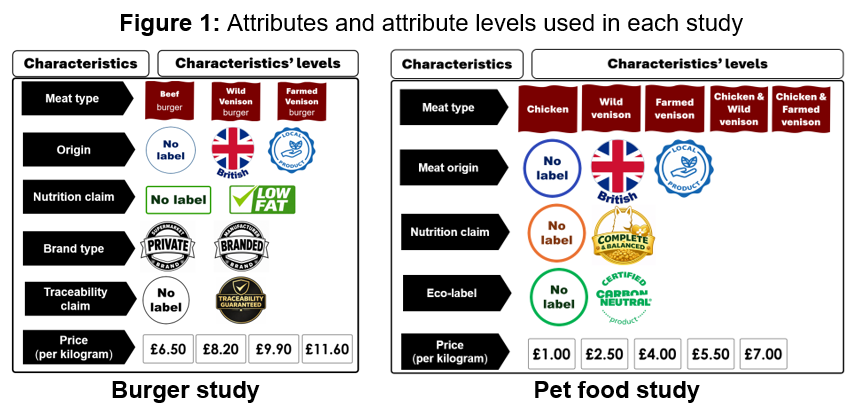
The study used two discrete choice experiment surveys to examine UK consumers’ and pet owners’ preferences and willingness to pay for venison products. Each survey included 1,650 respondents, representative of the UK population by age, gender, education, employment status and nation. Scotland was oversampled to support separate analysis. Pet food respondents were dog owners involved in purchasing dry dog food. In the human food experiment, participants chose between burgers differing by meat type, comprising beef, wild venison or farmed venison, as well as origin, nutritional claim, brand type, traceability certification and price. In the pet food experiment, participants chose between dry dog foods differing by meat type, comprising chicken, wild venison, farmed venison, or chicken blended with wild or farmed venison, as well as origin, nutritional claim, eco-label and price. Figure 1 presents the attributes and levels used in each experiment. Each respondent completed 12 choice tasks.
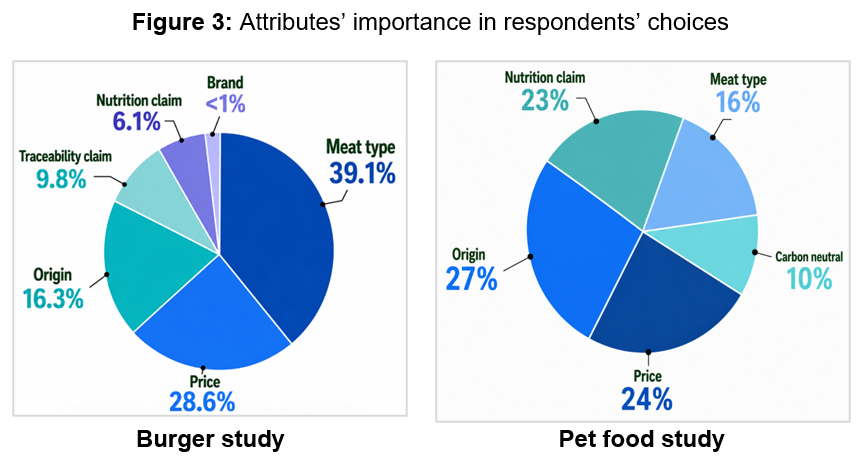
Product attributes influenced choices differently across the two experiments. Meat type accounted for 39.1% of burger choices, compared with 16.0% of dog food choices. Pet owners placed greater importance on nutritional claims and product origin than burger consumers. Figure 3 compares the relative importance of attributes across both experiments.
Results
Respondents consistently valued venison-based products less than comparable conventional meat products, as shown in Figures 4a and 4b. This gap was evident for both burgers and dry dog food, although blending venison with chicken increased pet owners’ willingness to pay. The findings indicate that competitive pricing and blended products could help increase demand. Pricing interventions are likely to have the strongest effect in the burger market, where consumers were more responsive to price changes.
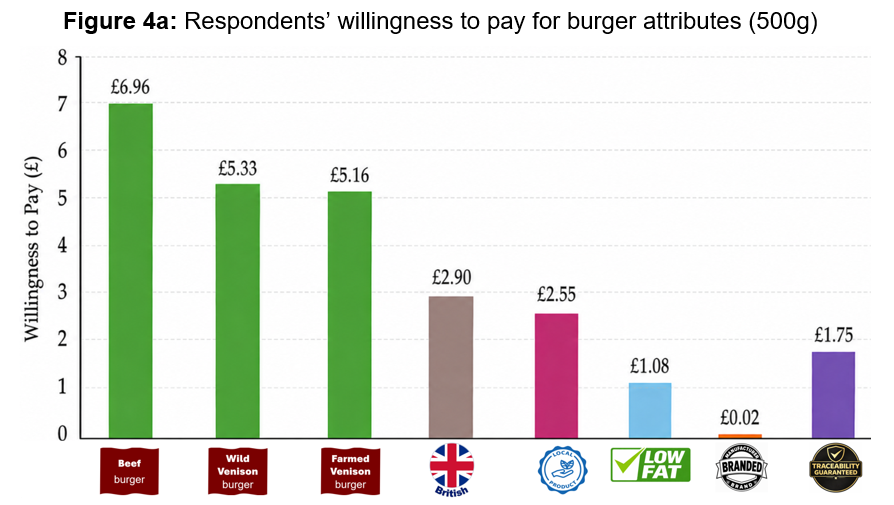
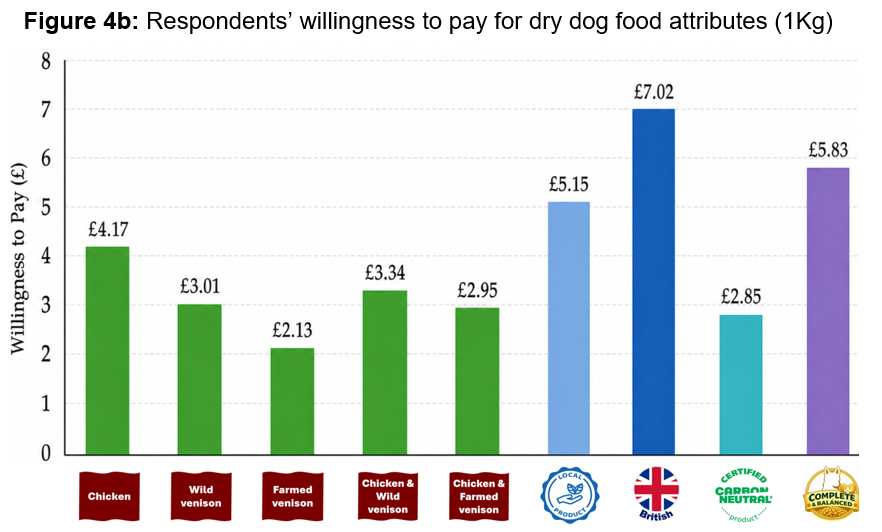
Origin, nutritional, traceability and carbon-neutral claims increased product value. For example, respondents valued a British label at an additional £2.90 for venison burgers and £7.02 for venison dog food. Providing information about venison’s environmental, societal and nutritional benefits increased willingness to pay for wild venison by 16% for burgers and 71% for dog food.
Benefits
Improve the price competitiveness of venison
Consumers and pet owners were willing to pay less for venison than for comparable conventional meat products. Measures that improve venison's price competitiveness, such as promotional campaigns, temporary discounts, or targeted subsidies, particularly following periods of increased wild venison supply, could encourage consumers to substitute beef or chicken with venison. The estimated price elasticities indicate that such measures are likely to be particularly effective in the human food market.
Communicate the wider benefits of venison
Providing information on the environmental, societal and nutritional benefits of sustainable deer management significantly increased respondents' willingness to pay for venison while reducing willingness to pay for conventional meat. Public awareness campaigns highlighting the contribution of venison consumption to biodiversity recovery, habitat restoration, climate objectives, road safety, rural livelihoods and sustainable deer management could therefore play an important role in increasing demand.
Increase value through product claims and certification
Consumers and pet owners were willing to pay substantial premiums for products carrying desirable claims, including British/Scottish or local origin, nutritional claims (e.g. Low Fat for human food or Nutritionally Balanced for pet food), traceability certification, and Carbon Neutral claims. Wider adoption of these claims provides an opportunity to increase both the acceptance and market value of venison-based products while better communicating their quality and provenance.
Unlock the potential of the pet food market
The findings indicate that the pet food sector offers significant potential for increasing venison utilisation. Compared with consumers purchasing venison for human consumption, pet owners placed considerably less importance on the type of meat used in the product, suggesting greater openness to substituting conventional meat with venison. They also responded more strongly to information and value-added product attributes, such as origin and nutritional claims. Expanding the range of venison-based pet food products, including formulations that combine venison with conventional meat, could therefore provide an effective route for increasing demand, particularly for wild venison, while creating a valuable additional market for the increased supply of venison resulting from sustainable deer management.
Project Partners
Faical Akaichi (SRUC)
Chen Ai (SRUC)
Montse Cost Font (SRUC)
Cesar Revoredo-Giha (SRUC)
Ruth Slater (Rowett Institute)
David Watts (Rowett Institute)
Exploring Britain's Retail Venison Market - https://sefari.scot/research/exploring-britains-retail-venison-market
Scottish Venison – “The Taste and the Quality of the Meat is Fantastic” - https://sefari.scot/research/scottish-venison-taste-and-quality-meat-fantastic