Food banks remain the dominant response to food insecurity in the UK but are widely recognised as inadequate and undignified. Social supermarkets (SSMs) have emerged as a potential alternative, offering discounted food in a retail setting that restores choice and reduces stigma. This study provides the first quantitative evidence in the UK on low-income users’ preferences for SSMs. A discrete choice experiment with 1,000 participants found that affordability and food quality, particularly access to fresh food, are the most important features. Overall, the most preferred model combines high discounts (above 50%), a wide range of fresh food, direct non-food support, and a commercial delivery model. While promising, challenges around sustainability and supply remain.
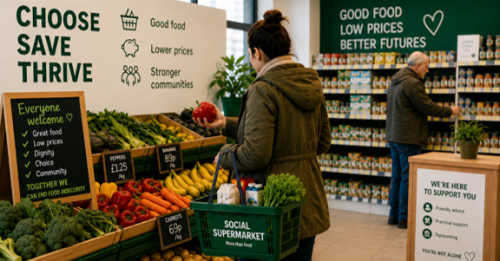
Main image made with ChatGPT 5.5 Plus
Stage
Purpose
Food banks have become the dominant response to food insecurity in the UK, driven by austerity, welfare reform, and rising living costs. While they provide an essential emergency lifeline, they are neither adequate nor sustainable. Typically used as a last resort by those experiencing persistent poverty, food banks offer inconsistent, surplus-dependent food, often with limited choice and poor quality. Users frequently report experiences of stigma, embarrassment, and loss of dignity.
Social supermarkets (SSMs) have emerged as a potential alternative, offering heavily discounted food in a retail setting that restores choice and reduces stigma. However, like food banks, many still rely on surplus and charitable systems. Despite growing interest, there is limited empirical evidence on how SSMs should be designed to meet user needs. This study addresses this gap by providing the first quantitative evidence in the UK on low-income users’ preferences for social supermarkets as an alternative to food banks.
Results
Methods
This study uses a discrete choice experiment to examine preferences for social supermarkets as an alternative to food banks. A total of 1,000 adults in the UK with an annual household income below £20,000 participated in an online survey. Participants were presented with a series of hypothetical social supermarket options and asked to choose their preferred alternative.
Each option varied across key features, including the level of price discount, the range of food products, the type of organisation (community or commercial), and the availability of additional support services. These attributes were developed in consultation with stakeholders, including policymakers and food aid providers, to ensure real-world relevance.
In addition to social supermarket options, respondents could choose a cash alternative (£30 per week, with referral required) or opt out if none of the options was suitable. Responses were analysed using a mixed logit model to identify the most important features and the trade-offs users are willing to make.
The findings highlight important patterns in how low-income households engage with and perceive food support. While 26% of participants reported using food aid in the past year, most relied on food banks, with fewer using social supermarkets. Among those who did not seek support, lack of awareness and stigma were key barriers, alongside not perceiving a need.
Awareness of alternatives remains very low: over 80% of respondents had not heard of cash-based support, and nearly 80% were unfamiliar with social supermarkets prior to the study.
When presented with different social supermarket models, affordability emerged as the most important factor. Discounts accounted for 45% of preferences, followed closely by food range (38%), particularly access to fresh products. Support services had a smaller but still meaningful influence (15%), while the type of organisation had minimal impact (2%).
Overall, the most preferred social supermarket model combines high discounts (above 50%), a wide range of fresh food products, direct non-food support services, and a commercial delivery model, reflecting a preference for affordability, quality, and comprehensive support.
Notably, when a cash option was introduced, one in five respondents preferred it over any social supermarket alternative.
No significant differences were observed between respondents from Scotland and those from the rest of the UK in their preferences for the characteristics of social supermarkets.
Benefits
Social supermarkets offer a more dignified and flexible alternative to food banks by allowing individuals to choose their own food in a retail setting. This restores autonomy and reduces the stigma commonly associated with food aid. Findings show that affordability and food quality are key priorities for users, with strong preferences for higher discounts and access to fresh, varied products. Social supermarkets can therefore address some major shortcomings of food banks, particularly limited choice and poor-quality food.
However, significant challenges remain. There is a clear tension between offering high discounts and maintaining financial sustainability. Many providers report that large discounts are not viable without external funding. Similarly, reliance on surplus food limits the ability to offer a consistent and diverse range of products, particularly fresh and culturally appropriate food. Capacity constraints also limit the provision of direct non-food support services, although indirect support remains feasible and valuable.
To maximise impact, social supermarkets should:
- Deliver meaningful discounts through targeted funding or partnerships
- Improve access to a reliable and diverse food supply beyond surplus
- Embed beyond food support through signposting and referrals
- Enable flexible delivery models, including commercial partnerships
While not a long-term solution to food insecurity, social supermarkets can play an important role in improving dignity and access as a transitional alternative to food banks.
Project Partners
Faical Akaichi (SRUC)
Cici Zhong (University of Edinburgh)
Cesar Revoredo-Giha (SRUC)
Ruth Slater (Rowett Institute)
David Watts (Rowett Institute)