Accompanying the rise of community landownership in Scotland, there has been an increase in research requests placed on specific communities. Our evidence suggests that such requests are becoming unmanageable, especially when respondents see very little benefit from research engagement. This project, in collaboration with the Community Landownership Academic Network (CLAN), has sought to find ways of aligning the needs of community landowners and researchers alike to develop guidance which can be used by researchers (and those who supervise them), community organisations and other actors to promote and encourage improved ethical research practice.
Main Image: Attendees of a workshop at UHI Perth June 2024, conferring where they are situated along X and Y axis as researchers, community members, funders, or supervisors.

Stage
Purpose
Community landownership in Scotland has increased over the last few decades, and with this there has been an increase in the requests asked of community landowners to not only manage the land and support local opportunities in their area, but to share their stories. These have been in various forms, including news articles and films, but this project has specifically focused on the rising numbers of research requests placed on community landowners.
This project brought together robust evidence to develop practical, shared guidance that supports ethical, manageable and mutually beneficial research relationships between community landowners and researchers.
Methods
The project comprised a substantial literature review, looking into academic theory of ethics and community-based research, in addition to reviewing the wealth of resources for improved research practice. There are many protocols already in existence in international contexts, notably touted by Indigenous communities, which helped to inform our work. The project then utilised a phased approach to collecting and synthesising data, incorporating interviews, surveys, workshops and industry events to hear directly from community organisations, membership bodies, researchers, students, supervisors, and research funders.
Results
The literature review highlighted that ethics is often defined as the principle of ‘doing no harm’ but in fact it represents a complex system of moral principles that, in academic work, should guide researchers in attempting to conduct their work responsibly. Our review found that ethical research requires continuous reflection, particularly in contexts where power imbalances are embedded. For community-based researchers, ethical engagement extends beyond formal approval processes to encompass wider considerations including the examination of one's own beliefs and how they influence the research, respecting local knowledge and being attentive to power dynamics. Ethics should be understood not simply as a regulatory requirement but as a foundation for rigorous, socially just, and reflexive research practice.
Putting ethical principles into practice can be difficult. Our research found that there are often structural barriers to this, such as tight funding schedules, and good practice is often highly dependent on individual relations, actions and behaviours. However, we found that there are certain practices which should be adopted by researchers and communities alike to ensure better ethical practice. These included upholding transparency and trust, consent (and confidentiality), respect, reciprocity and responsibility, communication, and time.
Our report identifies key pieces of guidance for researchers and communities when engaging in research projects, providing suggestions such as how to build relationships, support better communication, appropriately consider research incentives and ensure outputs and findings are fed back in timely and useful ways. We situate this guidance along ‘the research journey,’ looking at interventions and best practice before, during and after research projects.
Benefits
Our findings and forthcoming guidance provide a clear framework for improving ethical research practice and outcomes for both researchers and community respondents. The evidence shows that current ethical requirements in academic research should be treated as an absolute minimum baseline, and that high-quality research must go beyond compliance to actively benefit the individuals and communities involved, while maintaining research integrity. Community organisations should, in most cases, have the opportunity to be involved in the design and delivery of research, and have a realistic expectation that findings are fed back in a timely and accessible fashion. This will lead to a mutually beneficial relationship between researchers and the wider community.
This project demonstrates that meaningful ethical practice is strongest when community organisations engage in the design, delivery, and dissemination of research. Community partners should have clear expectations around how their time, knowledge and contributions are valued, including timely, accessible feedback of research findings.
Embedding principles such as transparency, reciprocity, responsibility, and respect throughout the research lifecycle supports more equitable, sustainable, and mutually beneficial relationships between researchers and communities.
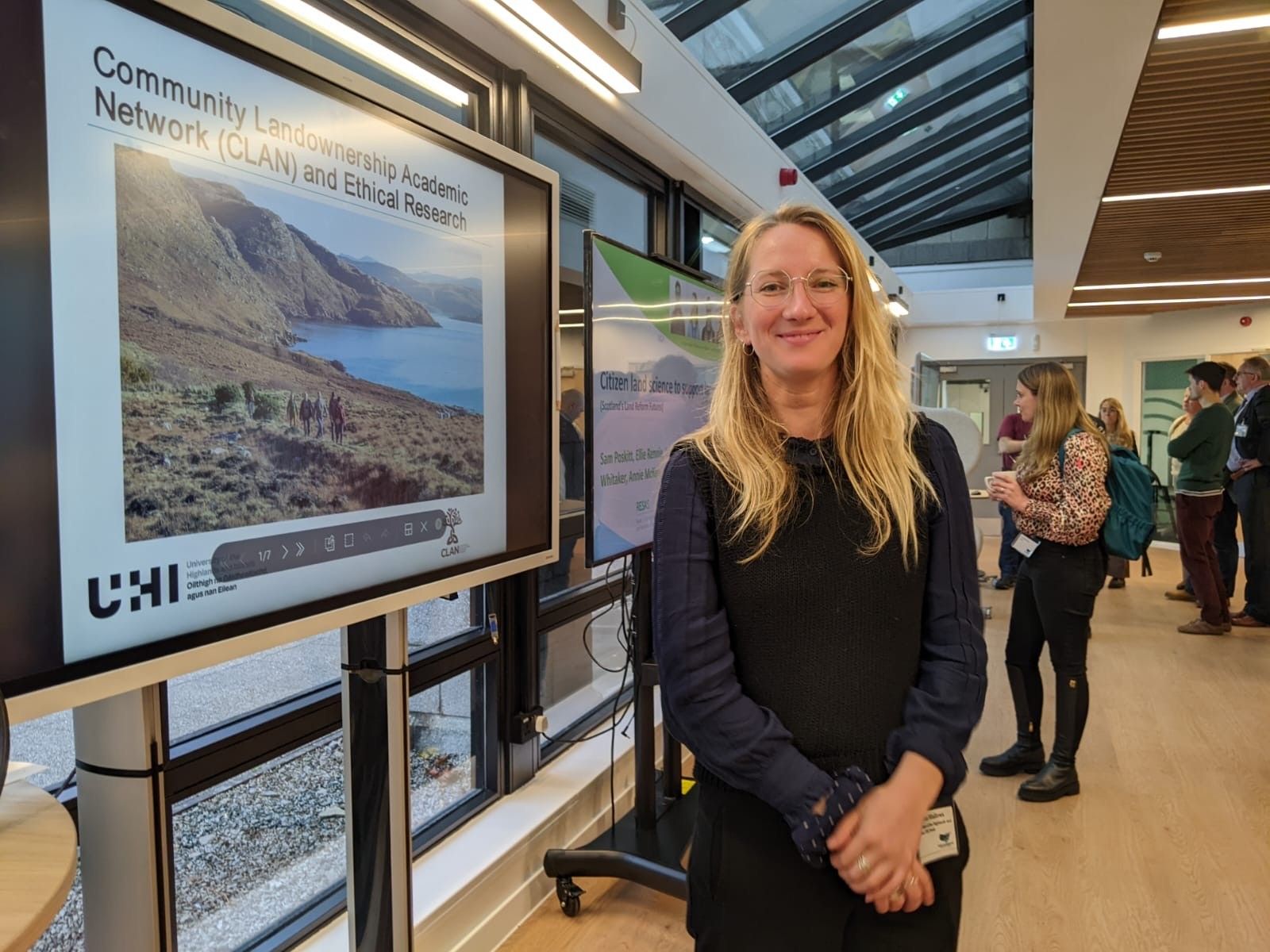
Research presentation at the Land Reform Futures Symposium, November 2025