Starting with a mind map
The first step in the process was conceptual rather than visual. Before any cards were designed, we developed a detailed mind map to clarify the purpose of the game. At its core, the aim was simple: to help players understand the relationships between common livestock diseases and how they are controlled.
We wanted the game to do three things:
- Reinforce key disease–control relationships
- Encourage discussion between players
- Translate scientific knowledge into practical understanding
The mind map helped identify the core pillars of the game: diseases, control strategies, learning outcomes, and gameplay mechanics. It also forced us to think carefully about the audience. This wasn’t intended as a purely academic exercise — it needed to be accessible to a general audience, including, farmers, students, and early-career professionals.
Choosing the content: from brainstorming to evidence
The next phase involved intensive content development. Through a series of brainstorming sessions, we built an initial list of livestock diseases relevant to the UK. We quickly narrowed the focus to cattle and sheep to keep the scope manageable and meaningful. There might be an option to include pig diseases as an expansion pack in the future.
Diseases were prioritised based on three criteria:
- Relevance to real-world farming systems
- Educational value
- Clarity of control strategies
This led to a core set of health conditions, including bovine viral diarrhoea (BVD), parasitic worms, mastitis, bluetongue, and Johne’s disease, alongside higher-impact but less common diseases such as foot-and-mouth disease. Each disease was mapped against realistic control strategies like vaccination, biosecurity, hygiene, and pasture management.
One of the most important steps was ensuring accuracy at the time of development. Control strategies were cross-checked against current veterinary guidance to avoid oversimplification. The aim was not to dilute the science, but to translate it into something intuitive and usable.
Designing the gameplay
Once the scientific backbone was established, the real creative challenge began, i.e. turning knowledge into a playable system.
The core mechanics emerged from another round of brainstorming. We settled on a domino-style matching system, where players connect disease cards to relevant control cards. This approach offered two key advantages: it was easy to learn, and it naturally reinforced correct associations.
Each player builds a “farm” in front of them by linking diseases and controls through edge-matching cards (Figure 1). The scoring system rewards players for successfully controlling diseases while penalising uncontrolled risks. This structure mirrors real-life livestock health management, where prevention and early intervention are key.
Importantly, the game was designed to be quick to play and easy to understand. The intention was not to create a complex strategy game but an engaging learning tool that could spark conversation and curiosity.
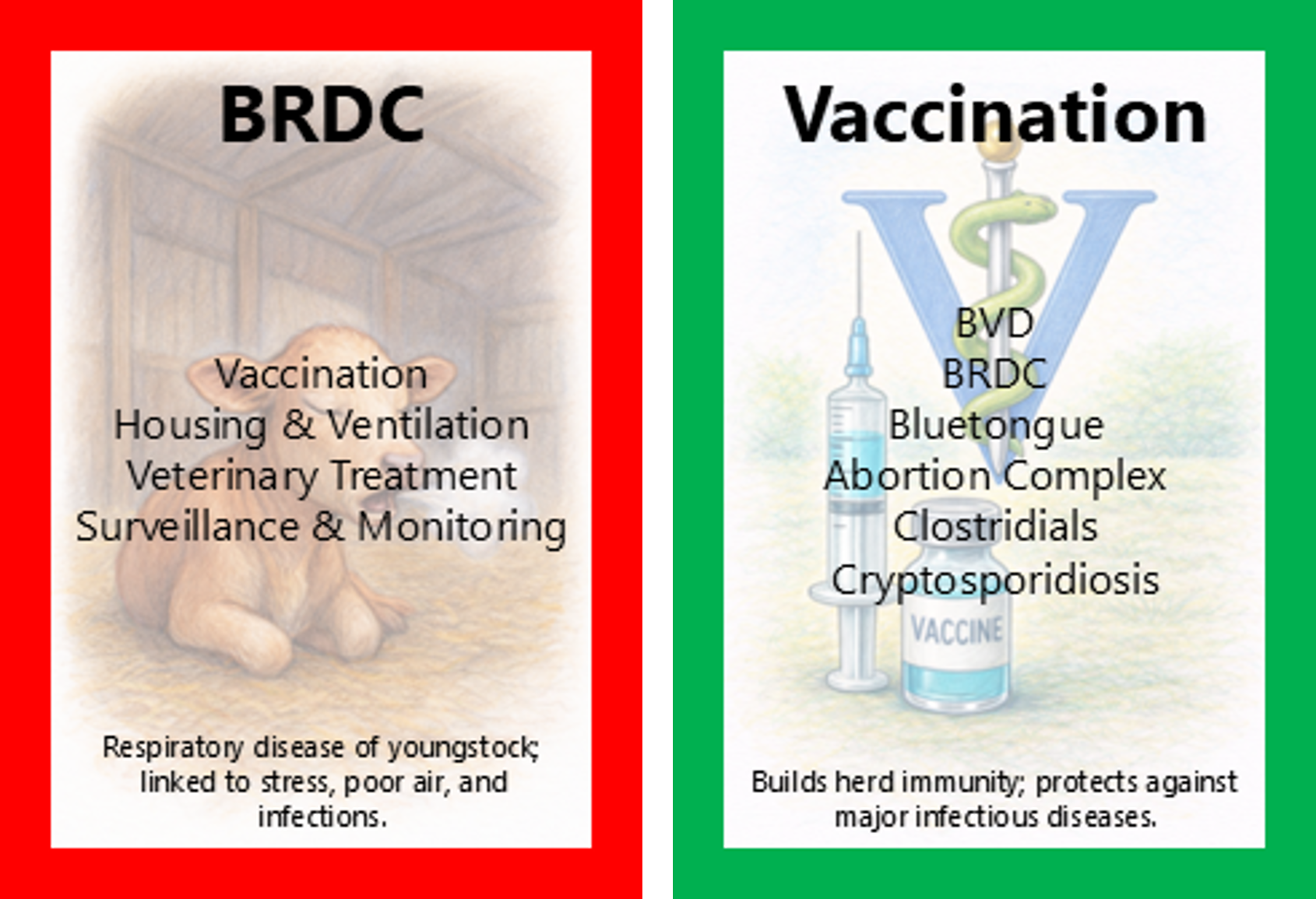
Figure 1: Example of a disease card (left) and control card (right)
Bringing the game to life: illustration as communication
Visual design became one of the most unexpectedly rewarding parts of the process. Scientific accuracy remained important, but the illustrations also needed to be approachable and emotionally resonant.
We experimented with different styles before settling on soft coloured-pencil illustrations. This style struck a balance between realism and warmth — scientific enough to feel credible, but friendly enough to invite engagement.
Each card illustration was carefully considered. Rather than abstract icons, we used small narrative scenes, for example a coughing calf for respiratory disease, or a sheep rubbing against a fence for scab. These visual cues help players intuitively grasp concepts even before reading the card text.
Control cards followed a similar philosophy. Instead of generic symbols, they depict recognisable actions: vaccination tools, open barns for ventilation, or farmers coordinating across fields. The aim was to make the visuals tell part of the story.
Iteration and refinement
Like any project, the development process was iterative. Early prototypes revealed practical issues — from card layout and readability to gameplay flow. Some diseases were too niche, some mechanics too complex, and some visuals unclear at small print sizes.
Through repeated refinement, the game gradually became more coherent. Simplifying the disease list improved clarity. Adjusting the scoring made gameplay more intuitive. Harmonising the illustration style helped the deck feel unified.
In many ways, this iterative process mirrors scientific research more than traditional game design. Hypothesis, test, refine — the same cycle applied, just in a different medium.
Beyond a game: towards a reusable approach
While the original goal was to create a novel knowledge exchange tool, one of the most valuable outcomes has been the process itself. The developmental pathway — from mind mapping and content creation through to mechanics design and illustration — is highly transferable.
At its core, the approach is simple: start with learning outcomes, translate knowledge into interaction, and design for clarity and engagement. These principles could be applied to a wide range of topics, from antimicrobial resistance and climate resilience to public health and environmental risk.
In that sense, the project has evolved from a standalone output into something closer to a toolkit for creative science communication. It demonstrates that complex research themes can be embedded into participatory formats without losing rigour — and that playful approaches can still be evidence-based.
Lessons learned
As with any creative research process, a few key lessons emerged. One was the importance of simplicity. Early versions of the game contained more diseases, more mechanics, and more complexity. Simplifying both the content and gameplay ultimately made the educational message clearer and the experience more enjoyable.
Another lesson was the value of visual storytelling. Illustrations were not just decorative; they became a core communication tool. Well-chosen visuals helped bridge the gap between technical knowledge and intuitive understanding, especially for audiences less familiar with livestock health terminology.
Perhaps most importantly, the project reinforced the idea that creativity has a place in science communication. Exploring unfamiliar formats can feel risky, but it also opens up new ways of connecting research with people and practice.
Why this matters
At first glance, a card game might seem like a superficial output compared to more traditional research outputs, but its potential impact lies in reach and accessibility.
Knowledge exchange is often framed as one-directional — researchers sharing findings with stakeholders. Tools like this encourage dialogue instead. Games create space for conversation, shared learning, and reflection.
By embedding livestock health knowledge in a playful format, we can reach audiences who might not engage with conventional materials. Students can learn foundational concepts in an interactive way. Early-career scientists can explore creative communication methods.
By experimenting with new formats for knowledge exchange, projects like this help bridge the gap between research and real-world decision-making — a core aim of SEFARI Gateway’s work.
What comes next
The card game is now moving beyond the prototype stage. Future plans include printing several copies of the game, playtesting with different audiences at the Royal Highland Show, refining educational outcomes, and exploring potential expansions, such as additional species or regional disease packs.
More broadly, the project has opened new conversations about gamification in agricultural science. SEFARI Gateway’s support made it possible to take a creative risk — to explore an unconventional idea that sits at the intersection of science, communication, and design.
If knowledge can be shared over a table, through a deck of illustrated cards, all the better.
Illustration featured on the back of the cards
Blog written by Thomas Tzelos from the Moredun Research Institute.