Food security exists when all people, at all times, have physical, social, and economic access to sufficient, safe, and nutritious food that meets their dietary needs and food preferences for an active and healthy life. This definition is rooted in four essential dimensions, availability, access, utilization, and stability, and firmly grounded in the Right to Food enshrined in international law.
Speaking at this year’s World Food Day Ceremony in October, the Director-General of the Food and Agriculture Organization of the United Nations (FAO), Dr. QU Dongyu reminded the world that “Hunger knows no borders” and that “the challenge of food security requires unity among peoples and nations.”
Indeed, achieving food security requires a true transformation of our agrifood systems, to make them more efficient, inclusive, resilient, and sustainable. Sharing expertise, knowledge and information is key for that.
FAO is a globally recognized knowledge Organization that has been providing comprehensive data, guidelines and analysis through dashboards, databases, and a series of flagship publications for the past 80 years.
In doing so, the Organization supports a wide range of agrifood stakeholders including policymakers, farmers, and researchers.
The State of the World collection, for instance, is a series of flagship reports presenting status and trends on a wide range of thematic areas, every year. Themes covered include agrifood systems transformation, sustainability, food security, malnutrition, financing mechanisms, trade dynamics, nutrition policy coherence, forest resources, innovation, climate resilience, sustainable fisheries & aquaculture, blue transformation, land & water resource management, and soil health.
Moreover, FAO offers many more valuable resources, like the Hand-in-Hand Initiative’s Geospatial Platform, the transparency portal, and the FAO eLearning Academy.
The conference in Edinburgh underlined the key role of partnerships to achieve food security. Identifying the most effective pathways, from local production to global supply chains, and addressing food insecurity with evidence-based solutions.
I believe that there is ample space for solid collaboration between the SEFARI Gateway and FAO in the future and I look forward to our joint work for a world without hunger!
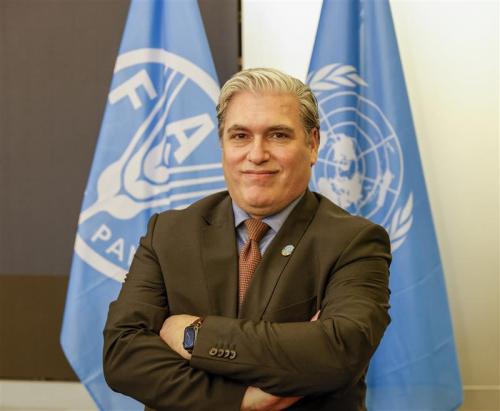
Raschad Al-Khafaji
Director, FAO Liaison Office with the European Union and Belgium
Brussels
FAO's official open repository, providing access to all of its publications, can be found here.
To learn more about FAO’s work on measuring hunger, food security and food consumption, click here.
To read the latest FAO flagship publication The State of Food Security and Nutrition in the World (SOFI 2025), click here.
To explore the Hand-in-Hand Initiative and its Geospatial Platform, click here.
To access the FAO eLearning Academy, click here.