This project assessed how Scotland’s Agricultural Knowledge and Innovation System (AKIS) can support a just transition to sustainable and regenerative agriculture. It found that while strong technical expertise and active farmer networks exist, the system is fragmented and lacks the coordination, long-term funding and transition-focused support required for whole-farm change. Farmers rely heavily on peer learning and practical experience rather than formal advisory systems. The research highlights the need for a more coherent, relational and well-resourced AKIS to enable meaningful and inclusive agricultural transformation.
Photo credit: Luz Maria Lozada
Stage
Purpose
Scotland has set ambitious policy goals to become a global leader in sustainable and regenerative agriculture, supported by the Vision for Agriculture (2022), the Agriculture and Rural Communities Act (2024), and the Code of Practice (2025). Delivering this transition depends on an effective Agricultural Knowledge and Innovation System (AKIS) that can provide farmers with the skills, advice, and support needed to navigate complex, long-term change.
This project was commissioned to evaluate whether Scotland’s current AKIS is capable of supporting a just transition, one that is environmentally effective, economically viable and socially inclusive. The research aimed to understand how knowledge flows through the system, which actors influence farmer behaviour and where gaps exist in advisory capacity, coordination and access.
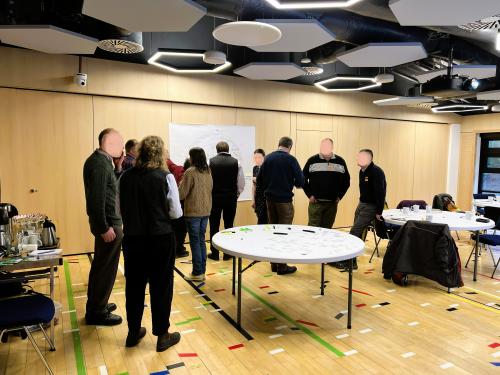
Using a mixed-methods approach, including literature review, surveys, interviews and workshops with over 120 participants, the study examined structural, functional, innovation and institutional dimensions of AKIS. It also explored how well the system supports whole-farm transitions, rather than incremental improvements.
The work responds directly to the development of Scotland’s Tier 4 support framework, which is intended to strengthen knowledge exchange, advisory services and innovation. Its purpose is to inform policy and system design so that AKIS can better support farmers facing climate pressures as well as market uncertainty and evolving regulatory demands.
Results
The research found that Scotland’s AKIS has strong foundations but is not yet configured to support large-scale regenerative transition.
A key issue is structural fragmentation, with multiple organisations operating without clear coordination or entry points for farmers. This creates duplication, gaps in support and confusion for farmers and crofters. While technical expertise exists, functional capacity is uneven, particularly in supporting whole-farm, multi-year transitions rather than single-issue improvements.
Farmers consistently identified peer-to-peer learning and on-farm experimentation as the most effective drivers of change. Survey findings show that 100% of farmers learn from other farmers and over 90% rely on their own experimentation, while engagement with formal research and advisory systems is much lower. This highlights the importance of experiential and relational knowledge pathways.
However, the system lacks sufficient facilitation skills, consistent long-term advisory relationships and integrated financial–technical advice. Monitoring and evaluation frameworks are also misaligned, focusing on short-term outputs rather than long-term outcomes such as soil health, biodiversity, or business resilience.
Capacity gaps are most pronounced in remote, upland and smaller-scale systems, where access to advice and resources is limited. Short-term funding cycles further undermine continuity and collaboration.
Overall, AKIS currently supports awareness and incremental change but lacks the coherence, stability and transition-focused capability required for systemic transformation.
Benefits
This research provides a clear evidence base for improving how Scotland supports farmers and crofters through agricultural transition.
For policy, it highlights the need to move beyond fragmented, compliance-driven knowledge transfer towards a coordinated, long-term system centred on learning, relationships and outcomes. It directly informs the design of Tier 4 support, including priorities such as transition-focused advisory services and improved system coordination, as well as funding reform.
For practice, the findings reinforce the value of peer networks, farmer-led innovation and facilitation. Embedding these approaches within formal support structures can increase engagement and adoption of regenerative approaches.
For farmers, crofters and communities, the research emphasises the importance of accessible, context-specific and financially grounded advice. By improving advisory coherence and investing in mentoring and facilitation, the system can better support diverse farming systems.
For the environment, a more effective AKIS enables the adoption of practices that improve soil health, biodiversity, and climate resilience at scale.
More broadly, the study demonstrates that achieving a just transition is not only a technical challenge but a systemic one, that requires investment in relationships, knowledge flows and institutional coordination. Strengthening AKIS in this way will be critical to delivering a resilient and inclusive regenerative agricultural future for Scotland.

Lismore. Photo credit: Luz Maria Lozada
Project Partners
Dr Luz Maria Lozada
Dr Gillian Banks
Dr Nikki Yoxall
Organisations
- James Hutton Institute
- Pasture for Life
- SEFARI Gateway
- NatureScot