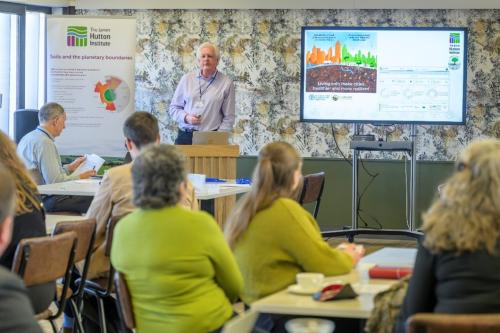
In the first event of its kind, the Scottish Soil Summit in Edinburgh brought together policy leaders, scientists and stakeholders to discuss how to tackle soil health.
The challenge? To figure out what should be the focus of Scotland’s soil monitoring programme. What sort of scheme would most effectively enable Scotland, and potentially the UK, to work out how to protect and improve its soils?
Should soil from across the entire country be included - from farmland, forests and urban areas? And what indicators should a monitoring programme focus on? Chemical factors such as pH, physical factors such as bulk density, biological factors such as microbial community? Or a wide selection?
Should samples be taken systematically from all areas at a “field level”, or targeted samples be used for modelling at a national level, that could then be used to draw wider conclusions?
Are existing data sets in Scotland adequate – the > 4 million pieces of soil data that already exist – or is more required? Is it the ‘right’ data? Does there need to be a repeat of the National Soil Inventory of Scotland (NSIS), sampled initially during 1978-1988 and again during 2007-2009, which would give data across almost 50 years?
These questions were thrashed out by invited delegates from across the UK at the summit at the Royal Botanic Garden Edinburgh, funded through the Healthy Soils for a Green Recovery research project, Scottish Government and SEFARI Gateway with support from ClimateXChange. Attendees included representatives from policy teams from all four UK nations, as well as stakeholder bodies such as NatureScot and leading soil scientists from the Scottish Main Research Providers including The James Hutton Institute and SRUC.
Throughout the day it was emphasised by Scottish Government policy representatives that the current priority in Scotland was to align with EU law on soil monitoring, although there was also agreement that a four-nations approach across the UK made sense and would be of value.
Scottish Government officials made clear there were four priority areas for a Scottish monitoring programme to deliver: monitoring carbon in soils to help tackle climate change, monitoring soil biodiversity, moving towards sustainable agriculture and tackling water scarcity.
And the summit heard that recent research carried out by Land Use Net Zero Hub, “Aligning 4 Nations Soil Monitoring” project, had revealed strong consensus over indicators that should be included across the 4 Nations of the UK.
However, as one soil scientist emphasised, the “elephant in the room” was how the monitoring scheme would be paid for. There was discussion about involving industry to a greater extent, acknowledging existing businesses such as DIAGEO, Nestle and First Milk who have supported initiatives to date. Moreover, making better use of established networks at a catchment level to collate data supporting policy was a key theme.
A presentation to the summit on the Soil Nutrient Health Scheme in Northern Ireland - a huge sampling scheme prompted by the poor state of water quality due to phosphorus leaching from farmland- revealed it had cost £45m already. This soil sampling scheme, which only involved agricultural soil, had sampled 650,000 fields covering the entirety of Northern Ireland.
However, government officials made it clear that in Scotland such a scheme would not be affordable and instead national-level data needed to be used to inform modelling from which wider conclusions could be drawn.
Roy Neilson, event organiser and soil ecologist at JHI, was encouraged by the progress made at the summit.
“It was a fantastic day. We hoped there would be robust and detailed discussion. We got that."
“In the last year of the SRP colleagues will come together to develop a framework that we can take forward. We are in a fantastic position.”
He told the summit that keeping soil healthy is of critical importance, but is currently not enough of a priority, with for example 62% of European soils in a degraded state.
“Soil delivers very much for us as a society and yet we deliver very little back to it,” he said.
Many questions remain, such as how a soil monitoring scheme in Scotland will be funded, whether available data will be sufficient, or whether a third round of the NSIS is required, whether the four nations will harmonise their approaches, be driven by policy focus within their own borders, or strive to be “policy agnostic”.
However, the soil monitoring programme’s overall focus and purpose, the indicators that should be included and the questions it needs to address, are now clearer.
The summit showed the critical importance of getting the right people in the room together and keeping the focus on the questions that needed to be answered – a process deftly managed by facilitator David Lee, from David Lee Media and Events,
And perhaps that is the other key takeaway from this successful summit. Whether its persuading landowners to act on monitoring data to improve soil health or encouraging private enterprise to help fund soil improvement work, or fostering agreement between scientists, government officials and pressure groups to align on the focus of a soil monitoring programme, there is one ingredient that is crucial, and so often overlooked: strong communication.
Blog written by Jenny Fyall