Research into Nature-based Solutions (NbS) for managing low flows is advancing globally, however relatively few case studies in the UK exist. Here, we draw on findings from the Glenlivet Distillery case study; a rare UK example of the use of NbS for managing low flows. Results from this pilot study show that well-placed runoff attenuation features that temporarily hold water can boost baseflow and preserve low flows by enhancing groundwater recharge, whilst also reducing flood peaks. The research underscores that location, scale and hydro-geological context are critical to NbS effectiveness for low-flow enhancement, however, further data is required from wider sites.

Stage
Purpose
The research addresses one of the most pressing water management challenges of our time: how to maintain reliable low flows and water availability under increasing climatic extremes. Across the UK and globally, climate change is intensifying drought frequency and duration, threatening the sustainability of upland water resources that supply rural communities, ecosystems, and industries such as whisky distilling. At Glenlivet Distillery (Chivas Brothers), researchers explored ways to futureproof water supplies as current climate projections show there will be less water available during summer periods (see Glendell et al., 2024). Traditional hard-engineering approaches offer limited adaptability, prompting growing interest in Nature-based Solutions (NbS) that use natural processes to store and release water more sustainably.
Using the headwater of the Livet in northeast Scotland as a living laboratory, this body of research investigates how NbS can be designed to enhance groundwater recharge and maintain streamflow during dry periods. The site’s importance lies in its representation of many Scottish upland catchments where shallow soils, impermeable bedrock, and competing water demands create acute vulnerability to low flows. Through field monitoring, tracer analysis and physically based modelling, the research investigated the potential effectiveness of Runoff Attenuation Features, which are small, leaky barriers that temporarily store runoff and encourage infiltration, to increase water availability during dry periods. Ultimately, this work aims to inform evidence-based, catchment-scale strategies for climate-resilient water management, showing how well-placed, scalable NbS can balance industrial use, community needs, and environmental sustainability in upland regions.
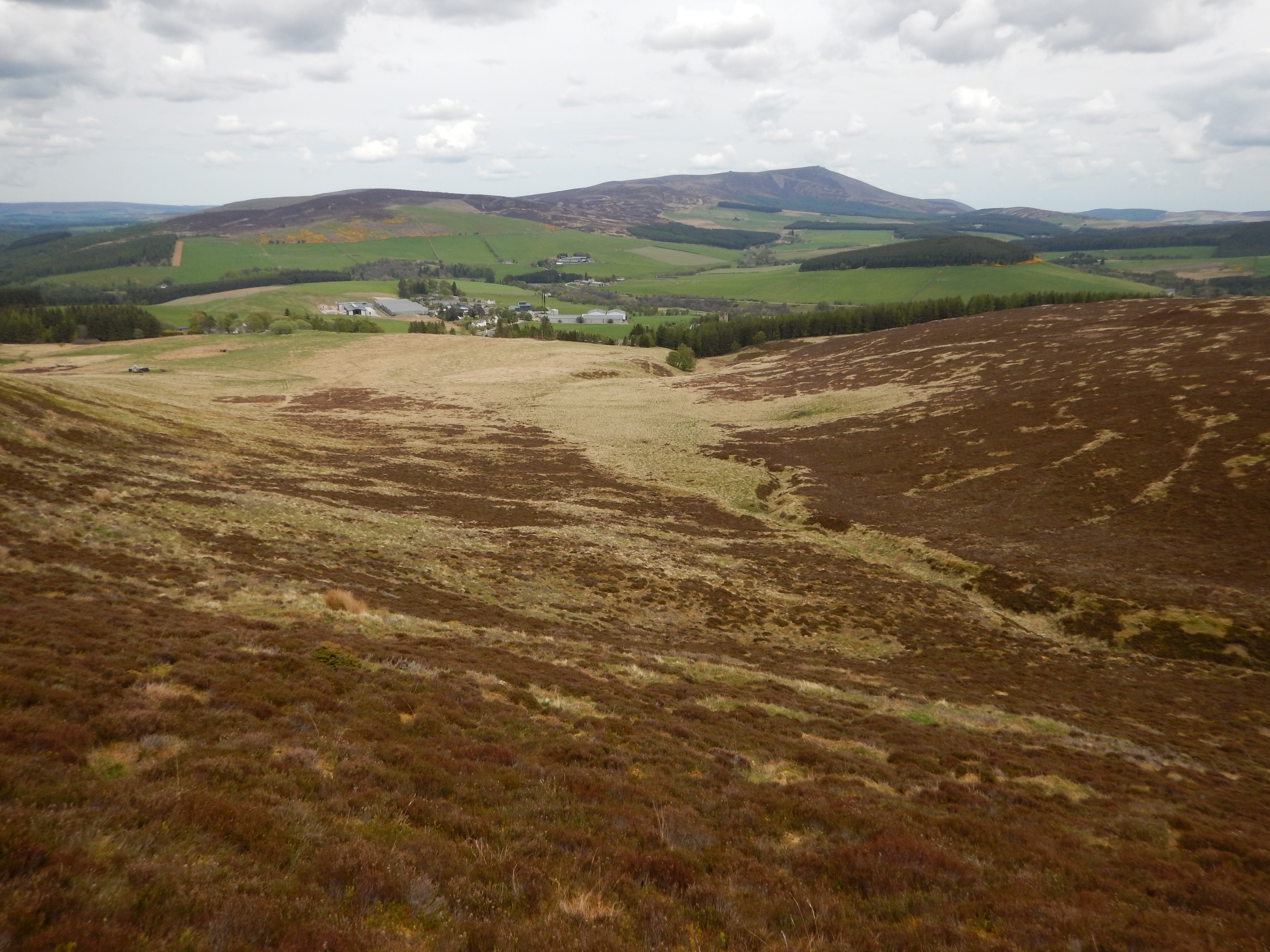
Glenlivet Estate. Photo credit: Dr Mark Wilkinson
Results
The research began with the 2018 drought investigation (Fennell et al., 2020), which used tracer-based methods (stable isotopes, electrical conductivity, temperature) to characterise water sources during extreme low flows. Results showed that groundwater sustained streamflow and buffered water during this hot and dry period. However, aquifer storage was heavily depleted, only recovering the following year after above-average rainfall. This established the need for interventions that enhance groundwater recharge and storage resilience.
Building on this, we applied a hydrological model to test scenarios of runoff attenuation features (Fennell et al. 2022) and found that their effectiveness depends strongly on location (soil type) and scale (storage volume and distribution), with spread out implementation on freely draining soils providing the greatest benefit. Forty proof-of-concept runoff attenuation features were built in 2020. Evidence revealed that these increase recharge to groundwater, although effectiveness is time-variable (Roberts et al., 2024), which may be attributed to fluctuating wetness conditions and changes in soil properties (Roberts et al., 2025). Overall, the installed pilot runoff attenuation features increased groundwater contribution to streamflow by ~4%, and low flows by ~1%, while reducing high flows by ~5%.
Fennell et al. (2023) integrated the data-based hydrological modelling with cost-benefit analysis, which also compared the effects of runoff attenuation features with those of tree planting. This revealed that RAFs improved low flows and were economically viable, whilst tree planting reduced low flows due to higher evapotranspiration and was not cost-effective.
Together, the results demonstrate that strategically placed runoff attenuation features offer a practical, scalable NbS for enhancing drought resilience and sustaining industrial and ecological water needs in upland environments like at Glenlivet.
Benefits
This body of research has achieved an advancement in understanding how NbS can be effectively designed and implemented to enhance low flow resilience in upland catchments in Scotland. The studies have provided robust empirical and model-based evidence on the hydrological behaviour of a drought-sensitive system, identifying the critical role of groundwater in sustaining flows and demonstrating how targeted NbS interventions can strengthen this natural buffering capacity.
The integration of hydrological science, modelling, and economic analysis has produced practical insights for policy and water management. It shows that relatively small-scale, low-cost interventions such as Runoff Attenuation Features can deliver measurable improvements in low flows and drought resilience, making them a feasible alternative or complement to traditional engineering solutions. However, further research is needed to explore how these measures work at scale and in different catchment settings.
These findings are highly relevant to wider issues of climate adaptation, water security, and sustainable industry. As droughts intensify globally, sectors dependent on consistent water supplies, such as agriculture, energy, and whisky distilling, must adapt to more variable conditions. Ongoing work is expanding the monitoring across Speyside at Glenlivet, Glenburgie, Aberlour and other distilleries to map surface- and groundwater connectivity, assess drought resilience under varied geology and land use, and model which nature-based water-management solutions are most effective across the region. We will also investigate wider measures in the AiM NbS project, for example, that are currently implemented for flood risk management purposes, for example, at Glensaugh.
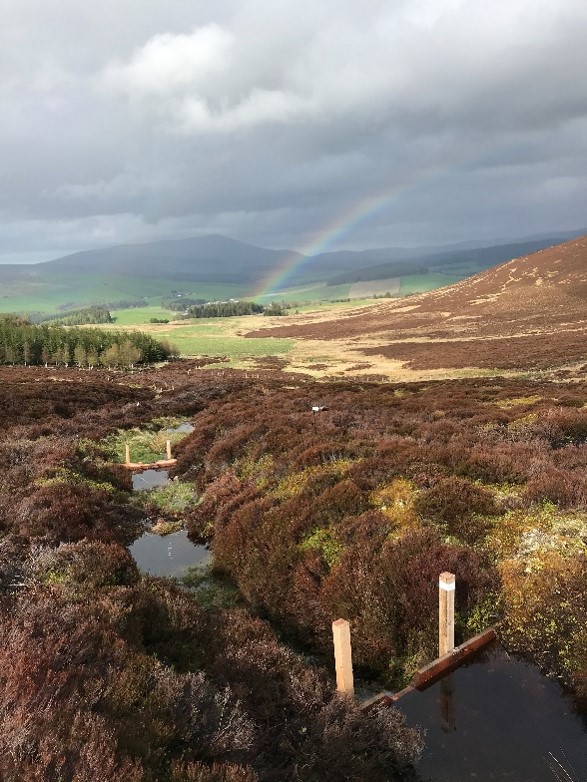
Example of a nature-based water-management solution. Photo credit: Dr Martyn Roberts, James Hutton Institute
Case study written by Dr Mark Wilkinson (James Hutton Institute) and Dr Josie Geris (University of Aberdeen).
Main image: Nature-based solution on the Glenlivet Estate. Photo credit: Dr Mark Wilkinson, James Hutton Institute.
Project Partners
Dr Mark Wilkinson, James Hutton Institute
Dr Josie Geris, University of Aberdeen
Chivas Brothers (Ronald Daalmans)